“Did you all see the recent Adventist controversy?”
That’s the text message I woke up to yesterday in my Bible study WhatsApp group chat.
I’ve been hearing rumblings about the Southwest Region Conference of Seventh-day Adventists’ most recent Camp Meeting.
Every year, there seems to be a lot of criticism of the camp meeting of this conference, and this year, I won’t pretend like I know what all the criticisms are. But I heard some people mumble and mutter about Le’Andria Johnson… mutterings about how she had a substance abuse issue and how this conference loves to invite non-Adventists to sing.
Then I saw YouTube videos criticizing Claudia Allen, a pastor who spoke on the opening night of the Camp Meeting.
I’ll discuss this in order of service. Let’s start with the opening night.
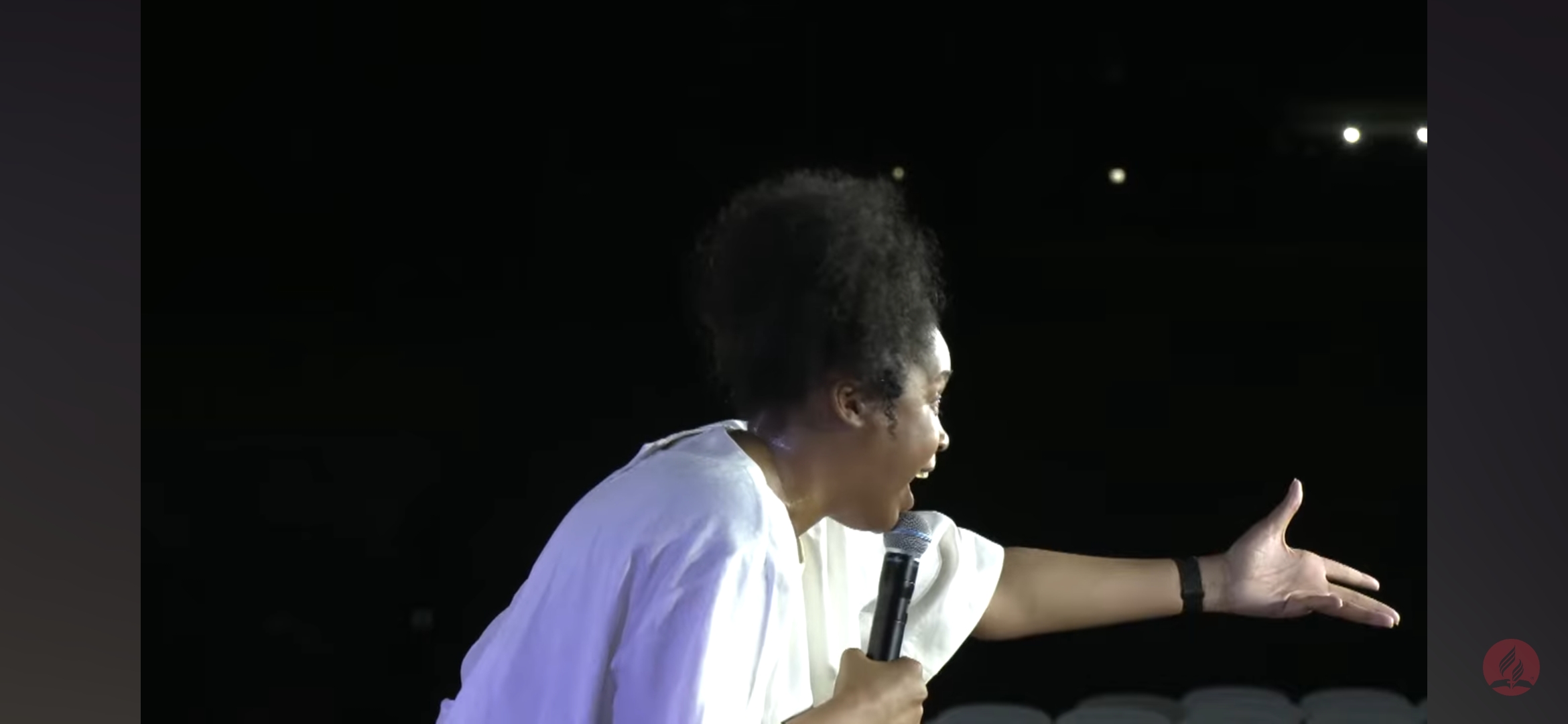
Claudia Allen Did Not Say to Do Away with Prophecy
Claudia Allen preached about Elijah visiting the widow of Zarephath, an unbelieving widow whom God said would feed Elijah. What an interesting parallel. A poor, unbeliever would minister to Elijah. She was in no position to minister to Elijah, and one might argue that she should worry about herself first before ministering to anyone else (sound familiar?), and yet that was what God had instructed. But if you follow some Adventists, they might have you believing that this unbeliever was not fit to do this, that Elijah might be better served by another Adventist — I mean, believer — or starve. I digress.
Allen’s sermon on the opening night of the Southwest Region Conference Camp Meeting this past weekend stirred something deep in me, because it wasn’t just a call to action, but a much-needed mirror held up to a church that often struggles to look at itself.
Allen spoke honestly about a painful truth: that as a church, we’re watching breath leave our bodies in a political context where faith and resources are being stretched or non-existent.
“When will breathlessness in our churches call us to revival? What are we asking for rain for? We’re calling for rain, but we’re asking for rain for what?” she exclaims.
And in that context — that Zarephath context where people are dying and losing their breath — in many Adventist spaces, prophecy has been privileged over people. We have spent decades dissecting Daniel and Revelation, creating timelines and charts, holding seminars, counting 2300 days, while sometimes failing to mobilize for the urgent needs in our communities. She said it plainly: maybe it’s time to put down Daniel and Revelation and pick up our responsibilities to each other.
And the backlash has been swift and loud. As usual, it seems that listening comprehension—and introspection—are in short supply. But what struck me is how familiar this pattern is. A Black woman and/or a woman in a pastoral role dares to challenge the status quo in love, and the Church doesn’t hear her heart—only its own discomfort.
We understand messages through the lens of our biases. If you have a bias that says that Claudia is a heretic, not a real pastor because she’s a woman, preaching a gospel of “liberalism” at an apostate camp meeting, you might have missed what she was actually saying. Again, here is where listening comprehension, like reading comprehension, is important: Claudia is not saying to do away with our prophetic message. She did not say that we must do away with prophecy completely. Understanding her words in the context of her message, she said not to privilege prophecy over people. Don’t study prophecy to the detriment of God’s people.
In other words, don’t be so heavenly-minded that you are no earthly good.
And it’s a salient point, because this church really struggles to be both prophetically potent AND socially conscious. It’s like we only know how to do one thing well. We are the weird nerd in the public playground who knows a lot of important stuff but struggles with connecting to people.
We’re not known for being on the right side of history. We’re always playing “catch up” if we even try to catch up at all. We consider conversations on social justice to be political, so we prefer to remain non-partisan and apolitical, while benefiting from the sacrifice of those brave enough to fight on the front lines. Allen mentioned how Adventists didn’t fight for the Title 7 protections of the Civil Rights Act from which they now benefit when seeking accommodation for Sabbath observance. We’re far too insular. We’d rather focus on the statue in Daniel 2 than protest or advocate for the most marginalized. There’s too much time spent watching the movements of the Pope and not enough time paid to the Advent movement or addressing the movement of people out of Adventism. We keep our heads in our Bibles and Spirit of Prophecy and rarely peek above the parapet to notice a world — and a church! — that needs not only our theology and prophecy but our compassion and our tangible, practical help. But claiming neutrality in the face of injustice is a political stance. And it isn’t the one Jesus took.
Jesus ministered to people’s physical hunger before He met their spiritual hunger. It’s hard to hear the Gospel when you’re hungry or hurting. He was people-centred in His ministry.
But far too often, as Adventists, we flip it around. We would rather peddle our theology. Our friendship evangelism always comes with ulterior motives. The sack lunch we distribute at the homeless shelter comes with strings — and a tract — attached.
But we’re in a moment right now where the world is crying out. All over the world, we’ve seen protests over Palestine and (not enough) protests regarding the other genocides happening in Sudan and elsewhere. In Ontario alone, we face a housing and homelessness crisis, growing healthcare inequities, and the steady erosion of public services.
And we needn’t look far to find the hurting. In our churches we boast of huge baptismal numbers but we are bleeding members while our members bleed.
Dr. Tiffany Llewellyn, founder of Adventists for Social Justice, asked in the ASJ Facebook group in the wake of the Canadian federal elections if there are any social justice-oriented Adventist churches out here.
I couldn’t name any.
I don’t hear of Adventist churches organizing rides to the polls during elections. I don’t see coordinated efforts to support protestors, to advocate for tenant protections, or to shelter those who are unhoused. We’re great at health fairs, food banks, and soup kitchens—and those are meaningful. We have Women’s Ministry Day and Religious Liberties Day like most Adventist churches. But like many organizations who seek my consulting services, we struggle with systemic change.
Where is our infrastructure for liberation? Where is our political theology?
There are so many things we could be doing:
- Partnering with tenant advocacy organizations or housing cooperatives.
- Organizing transportation to the polls
- Creating orientation guides for newcomers
- Hosting community town halls on education cuts or health care.
- Establishing safe rooms or transition housing for people experiencing domestic violence or homelessness.
- Supporting Black and Indigenous organizers doing justice work in our cities.
- Publicly supporting clergy—especially Black women—when they speak truth with love and conviction.
When I see the criticism of Dr. Claudia Allen (and Le’Andria Johnson), I hear something deeper: fear. Fear of being challenged, fear of change, fear of Black women leading with spiritual authority. It’s so ironic, because God has not given us a spirit of fear, but of power (2 Tim 1:7).
But I also see hope. Because sermons like Allen’s are necessary ruptures—cracks in the foundation where light can get in.
Let’s Talk about Le’Andria
The criticism of Le’Andria Johnson is a perfect case study of Adventist myopia, and how ironically uncompassionate we can be towards people.
Le’Andria was invited to sing before the main speaker’s sermon on Sabbath morning. And boy, did she sing. But you wouldn’t know, because all people online can seem to talk about is her belly, and her jeans. I’d love to say that I was surprised, but I’m used to the hypocrisy and hyper-critical nature of many Adventists.
Le’Andria isn’t different from any of you – any of us. She’s working through her substance abuse issues. The only thing different between you and her is that you know about her issues. You keep yours hidden and still show up at church. For some of you, your drug of choice may not be alcohol but it is illicit sex, gossip, lying, stealing, meanness – but you still roll up to church, smiling with your hot breath in people’s faces, singing on the praise team and even preaching talking about “Happy Sabbath.” Please.
Remove the plank in your eye. He who is without sin, cast the first stone.
There are people who sing, and then there are people who connect with what they are singing. Most weeks at church, you hear the former. But I watched the camp meeting service on YouTube. When Le’Andria sang “God Is,” it moved me. It moved the congregation. She sang it like she had a testimony, like she understood the words. When she sang and ad libbed, “I’ve still got to fast and pray, stay in the narrow way. I promise you I’m still trying to live my life clean every day…” she meant it and I felt it. She sang her testimony and who she knew God to be. And then she shared about her struggles. She testified.
Somebody in that congregation might have gotten their breakthrough because she was brave enough to share her story.
And what kind of church are we if people who are struggling (not people who have struggled, but people who are in the midst of struggling) can’t share their gifts with us? Can’t serve with us while they struggle? While they work out their salvation with fear and trembling?
At one point, Le’Andria said (paraphrasing), “You don’t know what it took to come here. It would have been far too easy for me to be in a bar,” and “I was in a bad space before I came today.”
Some people would take that as, “she’s not well enough to minister.” At least, that’s what people are saying about her online.
But I hear that and think, “If she weren’t in church, she’d be at a bar. Praise God someone invited her to church to sing!”
Secondly, I don’t see the big deal with Le’Andria singing.
(Also, alcoholism is a lifelong disease that has to be managed indefinitely. We live in a society that supports and encourages social drinking. There will never be a time when she’s finally “over it” and “healed enough” to minister. She needs community and not ostracization. So all these people online talking about how “she shouldn’t minister when she’s the one needing to be ministered to” lack key critical thinking skills and are ignorant. If that’s the standard, none of us should ever go into the pulpit or serve in a church office ever again.)
The irony is that the “healed and holy people” who say that people like her shouldn’t be “platformed” are often the same toxic people driving people away the very people who need to be in church from church and potentially a healing community.
We need to strike a balance between “protecting the flock,” and letting people worship with us. Be with us.
But church (as I know it) has never been a safe place. And so we perform. We arrive pressed and polished, feeling the need to be put together, meanwhile, we are emotionally frayed, spiritually exhausted, and isolated in our secrets. If only church could be a place where we could come unravelled. Most people are not ready for that type of messiness and honesty. But I digress.
On “non-Adventist” singers at Adventist meetings:
Firstly, we’re like the only denomination that calls people who are not Adventists “non-Adventists.” It’s weird. It creates an unnecessary wall between us and the rest of Christendom.
Adventism largely came out of Methodism.
The hymns that you love and think are holier than contemporary gospel were not written by Adventists. They were written by Baptists, Methodists, Wesleyans, Lutherans, Presbyterians, etc.
Everyone has fallen in love with the song “Goodness of God.” It was even sung at the most recent camp meeting in Ontario. But I’d like to remind you all that an Adventist didn’t write that song. We’re not known for our songwriting, unfortunately. What is the difference if we invited CeCe Winans – who popularized the song – to sing it versus our regular, degular praise team?
Discomfort is Not Conviction
I will expound upon this in a subsequent blog post, but let me also state this:
I need people not to confuse discomfort or guilt with morality and conviction.
Just because you are uncomfortable with something doesn’t mean it’s wrong.
As a Canadian of Jamaican descent raised in an Adventist church with mostly Jamaicans, I used to feel uncomfortable watching African American churches, regardless of denomination. I used to think that people whooping and hollering in a church service was wrong. But I was taught that it was bad. My discomfort was taught. People cherry-picked Ellen G. White quotes to support this assertion.
Then I decolonized my view of church. I learned that Ellen G. White, while honest and Spirit-filled, was a product of her time, had limited exposure to cultures outside of her own and was not immune to bias. And as I learned about how my ancestors worshipped before slavery and colonization, I realized that a lot of the ways of worship with which the Adventist church took issue were not because it was anti-God, as I was led to believe, but because it was anti-Black.
A lot of people have conflated conviction with comfort. I think that sometimes the Holy Spirit does speak through feelings of guilt, remorse and discomfort.
But not all guilt is Godly or God-given. Some of it is taught.
So if you watched the Camp Meeting and felt uncomfortable, you need to ask yourself why and interrogate your biases, remembering that the Bible is not synonymous with your bias and that the Spirit of Prophecy does not necessarily co-sign your prejudice.
Missing the Forest for the Trees
In a moment of poetic justice, Dr. Abraham Jules approached the pulpit and preached a sermon that directly addressed everyone’s criticisms. He preached about “how do we receive people from the hog pen?” How do we receive people? People who do not look like us or dress like us or talk like us. People.
And ironically, in the review of this Camp Meeting, these “present truth” YouTubers would rather hyperfocus on prophecy, soundbites and words taken out of context.
People are being snatched up off the street. People are dying in the church and outside of the church. Several genocides are happening. I wish we’d focus on that. There are so many YouTube videos from these so-called “present truth” Adventist creators out there criticizing Claudia and Le’Andria, and almost none talking about genocide. About sexual assault in our churches. About church hurt and religious trauma — you know — things that actually ail the heart of God (at least more than people quickening and having a praise break in an Adventist church).
There’s so much irony here I couldn’t make it up.
I hope that all of the people criticizing Claudia and Le’Andria are praying for them. I hope that the same amount of time and energy spent recording and editing YouTube videos and being keyboard warriors decrying these ministers and the Southwest Region Conference of Seventh-day Adventists were spent in humble intercession if people truly felt so pressed and passionate.
If anyone ever truly believes that I’m in actual spiritual trouble, I hope you’d pray for me instead of preying on me, tearing me down online and talking about me behind my back. 
I don’t write this because I have all the answers, but because I believe our church can be better. We can be bold and we can be brave (though we probably won’t be). But I do know that we can at least be human. We can still be faithful while also being just. We can remember flesh and spirit. We can believe in both prophecy and people.
If our love for prophecy overshadows our love for people, then we’ve missed the entire point (just like how people missed the point of Claudia’s sermon).
The Great Controversy is the victory of good over evil.
But the real and current controversy facing the Seventh-day Adventist Church is that we are impervious to human aches and hurting hearts.
Discover more from Simone Samuels
Subscribe to get the latest posts sent to your email.
