As a Canadian of Jamaican descent, I can’t even count how many times I’ve been back to the island of sunshine, reggae, good food and vibes — the land of wood and water. I loved visiting my aunts, uncles and staying at my maternal grandparents’ house in the Jamaican countryside. But among my most memorable activities was visiting the Rose Hall Great House when I was twelve years old.
When I heard that Nottoway House burned down last week, and when I saw Black people rejoicing (rightfully and understandably, might I add), and when I saw the ensuing conversation around turning plantations into resorts and wedding venues, I immediately thought of Rose Hall.
Rose Hall Great House in Montego Bay, Jamaica is one of the more memorable and well-known “great houses” on the island of Jamaica. A notorious site of colonial brutality and lore, it was the home of the “White Witch of Rose Hall” — the widow Annie Mae Palmer. During a tour of the site, tourists learn about the ways that she brutalized and killed her husbands and enslaved lovers. (White women held just as much power over and were just as brutal to the enslaved people as their husbands, as the book They Were Her Property describes).
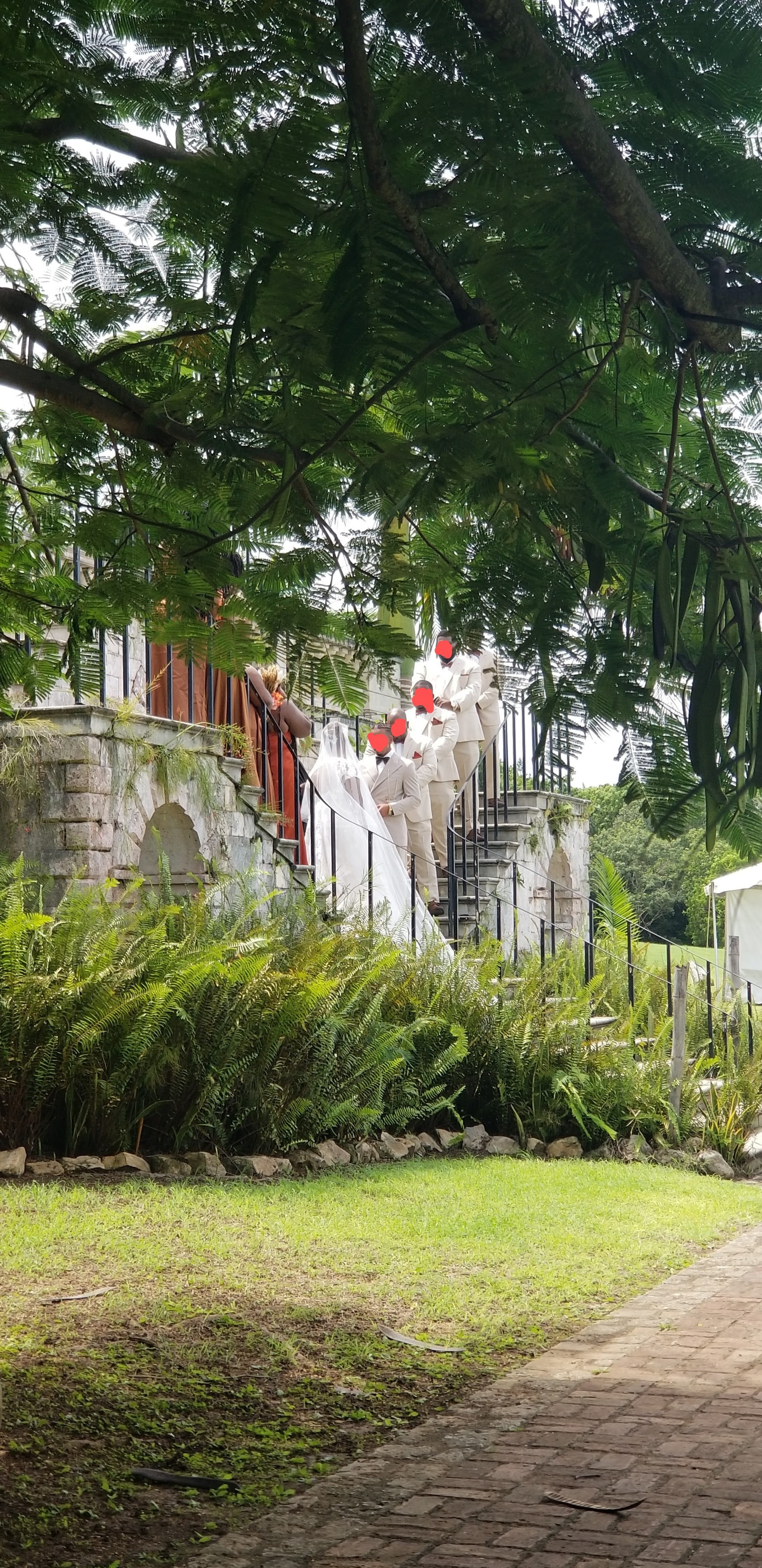
I visited the Rose Hall Great House again in 2022. Just like when I had visited when I was twelve, I could feel the heaviness and darkness as we walked through the house. The creaking floorboards reminded me of the cries of enslaved people beaten into submission. The ornate decorations contrasted with the destitution of the people denied liberty. The whole draw of Rose Hall centers on how Annie Palmer tortured her lovers. During the tour, which doesn’t shy away from the fact that enslaved Africans were tortured and killed there, I happened upon a wedding.
The couple appeared to be African American. The scene—white chairs, coordinated attire, smiling guests—was picturesque. But it unsettled me.
There, at a site where my ancestors’ screams were likely ignored by the same walls now wrapped in tulle and silk, vows were exchanged.
I took a photo. Not to shame, but to sit with the discomfort.
Is it ignorance? Willful disregard? Reclamation?
I wonder if we need to have a nuanced discussion on the internalized racism of Black people or the relationship of African Americans to the torture sites of other Black people in the diaspora.
It’s one thing if White people have their weddings at a former plantation. At the very least, it is woefully tone deaf and ignorant, and at most, it is horribly offensive. Many people have drawn parallels between what happened at Auschwitz with what happened on plantations. We’re not in the oppression Olympics, but there seems to be this pervading sense that the trans-Atlantic slave trade was “not that bad” and that people — but especially Black people — should get over it (epigenetics, Post Traumatic Slave Syndrome and intergenerational trauma be damned).
When I asked this question on Threads (ignorance, willful disregard or reclamation?), a White woman (predictably) said this:
“This is putting the past behind and moving on. A place has done nothing only the people that once resided there and now no longer reside there. So now it is only a lovely venue.
Why do people visit the pyramids? They were built by slaves and the death of slaves. Yet people still go visit.
Many of the great Roman structures were built by slaves.”
While we recognize that the Holocaust was genocide, and we talk about the genocide in Rwanda, few people discuss the trans-Atlantic slave trade in terms of genocide. The brutality is glossed over in casual conversations and polite company. Like the person above, people equate a plantation to a pyramid — just an innocuous historic scene, a site to visit on your way to brunch. “It too was built by slaves.” Too many people still do not understand and internalize the gravity of what happened on plantations. People raped systematically. Families torn apart, never to see each other again. People lost limbs and digits, branded like cattle, chained like dogs, starved and deprived, lynched, tarred and feathered, fed to alligators, beaten within an inch of their lives, disfigured for fun and for profit. For centuries. Entire bloodlines, stories and memories erased.
I’m sorry that Black trauma has become normalized to you, but I need people to realize and understand that life on a plantation was just as brutal, cruel and torturous as Auschwitz — and yet, we would never see anyone getting married at a concentration camp, much less Jewish people. Plantations should be treated with the same regard.
(Also, no one ever tells Jewish people to “move on” and “put the past behind them,” and this White woman definitely wouldn’t make that argument if random people were getting married at a concentration camp, but I digress.)
What does it mean when Black people celebrate at sites of Black suffering? Are we recreating harm? Reclaiming space? Or simply disconnected by the vast ruptures that slavery created between us?
I surmised that they were African Americans given their accents (they were Black, and Americans do have an unmistakable accent). What does it mean for Black Americans to have their wedding at a diasporic torture site? What would it mean if the wedding party were Jamaican (would Jamaicans even have a wedding at a Jamaican plantation? It feels like a very American thing)?
When I posted these thoughts on Threads, some said everything from I should “mind my own business” to “I shouldn’t assume they were African Americans” (who else could they be? They were Black. They weren’t Africans and they weren’t Jamaicans and they likely were not Canadians). But what was most alarming is that some thought that it was willful ignorance — “maybe they didn’t know.” I find it hard that the wedding and events coordinator glossed over the fact that enslaved people were murdered on those grounds. I mean, at the very least, it’s on the website. The same place where you say your vows is near the same place one of Annie’s lovers fell out of the window of the second-floor bedroom, broke his neck and died.
“Reclamation! Why not make the original plantation owners roll in their graves by having the descendants of the slaves they tortured use their former home as they please?”
“Maybe it’s kind of a slap in the face…. Ppl were tortured there, and to have a wedding , a celebration, of ppl that are the same race that was tortured…. Plantation owners are probably turning in their grave. And for those souls that endured the torment maybe they celebrated too? That’s something they wasn’t allowed… just trying to use a different point of view.”
“Think of it in another aspect, the evil, vile woman who owned Rose Hall would be rolling in her grave, knowing that black couples are choosing her former residence to share their wedding day with their friends and family. I look at this as a form of revenge against the nasty Witch of Rose Hall.
Congratulations to the beautiful couple.”
“Ive always felt it made the ancestors proud to see how far we’ve come. To know we are able to come back not as slaves but as happy and free black people that accomplished so much thanks to them. Its not cringe to me.”
“I’m from Jamaica. While planning my wedding, the wedding planner insisted on hosting at several plantations because we would be having a rather large wedding. My husband and I toured 1. Walked in, through the dining area and went right outside and said nope. There was a heaviness on that property that is hard to put into words.”
When the Nottoway Plantation in Louisiana burned down recently, I, like many others, rejoiced. Once the largest standing antebellum mansion in the U.S., it had become a luxury resort and wedding venue. There was no reckoning, no honest engagement with history—only aesthetics, preservation, and profit.
It was in keeping with the burning of other great houses in the United States and the Caribbean during slave rebellions. As someone said on Twitter, not everything can be decolonized. Some things must burn.
But if Rose Hall burned down, I would mourn.
Why the difference?
Nottoway was a Disneyland of denial, while Rose Hall—flawed as it may be—offers glimpses into the fragmented lives of my enslaved Caribbean ancestors. I learned about slavery in school, yes, but from the American perspective, even though I was educated entirely in Canada. I learned about Harriet Tubman and Dr. Martin Luther King, but I was an adult before I learned about Mathieu da Costa, Marie Joseph Angelique and Chloe Cooley (enslaved Black people of note in Canada) and older still before I learned about Nanny of the Maroons, Sam Sharpe and Paul Bogle (enslaved Black people of note in Jamaica). I have learned of my slave ancestry in bits and bites, in a patchwork fashion, piecing together whatever little bits of information I happen to come across. For those of us in the diaspora, where oral histories have been lost and archives are incomplete, even haunted houses can serve as portals to the past.
We need nuance in our conversations about plantation spaces.
Not all should burn. But not all deserve to stand untouched, celebrated, or commercialized either. And when it is commercialized in places like the Caribbean, we must also allow for the nuance that the commercialization is a result of neo-colonialism (i.e. tourism). We often want to reject capitalism, but most of us still engage with it out of survival:
“I think when it comes to Jamaica, it’s such a paradigm. Jamaica subsists on tourism and great houses bring in those dollars. Jobs are needed. I feel as long as great houses acknowledge the accurate history of the home and are a museum model as well, two things can coexist. History can’t be erased, but future generations can learn how strong our ancestors were. The issue with Nottaway, was they completely whitewashed what that house was, who built it, how the money was made, etc.. Reclaim.”
“I say it employs a whole ton of people that so many Jamaicans and their families benefit. Taxis, caterers, tour guides, waiters, in turn will trickle to benefit others.. farmers, landscapers etc. Sometimes we need to open our eyes and see the positives. The whole island was a plantation so go figure. When Jamaican don’t have tourists or a trade what will they do?”
Like some of the comments under my Thread echoed, for Black people, perhaps a wedding at a former torture chamber flies in the face of the horrors that were committed there. It juxtaposes pain with joy. Enslavement with liberation. Annie’s lovers could not truly consent to the sexual relations in which they were engaged. It is something to be able to consent to holy matrimony in a place where consent in romantic relationships was not possible.
And we, as Black people across the diaspora, need room to explore our varying relationships to these sites. To sit in contradiction. To ask hard questions. To heal.
The story of the plantation isn’t just about architecture or weddings—it’s about memory, rupture, survival, and the many ways we carry the past into the present.
Discover more from Simone Samuels
Subscribe to get the latest posts sent to your email.

Thank you, Simone, for sharing this. I’m glad I clicked the Threads teaser in Facebook and then followed your link here.
I am interested to know if the same is true for the land on which a plantation house resides/resided.
If the Rose Hall Great House suffered the same fate at Nottoway, and the grounds either remained to become a park, or were redeveloped with another place that could serve as a wedding venue, would that change the conversation? Or would the land which absorbed so much of the blood and remains of those tortured, enslaved people continue to carry the same meaning and the same consideration?
A different question but something that this brought to mind: In the U.S. (and Canada?) many of us now make land acknowledgements, trying to reconcile the present with the heinous things done to Indigenous people throughout the history of the place. Of course that’s not enough, but would something similar be appropriate to acknowledge the history that centered on slavery?
LikeLike
Thanks for reading and for such a thoughtful comment! I don’t know if I have an answer. I think, as it relates to Rose Hall and so many of the other great houses on the island, Jamaica relies so heavily on tourism and on the tourism opportunities of this venue, ironically because of colonialism. I think Nottoway (and Auschwitz) is situated in a different context (the US and Germany don’t rely on tourism and on tourism focused on these houses as much as Jamaica does), hence the need for a more nuanced discussion.
We do land acknowledgments too here in Canada but admittedly they have their limits; it’s tantamount to saying, “We recognize this land doesn’t belong to us but we’re still going to keep it.” Land acknowledgment without reconciliation and land return rings hollow in my opinion.
But to your point, I think any site that was the place of human atrocities should at least acknowledge those atrocities and not romanticize them. My understanding is that Nottoway does the latter.
LikeLike